Politics is personal. The people you know, how they feel about you, and what you owe each other shapes everything from daily opportunities to career-defining moments.
¶ How Relationships Work
Every NPC in UK Politics Simulator has a relationship score with you. These are displayed to the player in text form, ranging from Arch-Enemy to Devoted Ally. This score changes based on your interactions and shared history.
Possible relationship levels:
- Devoted Ally
- Trusted Ally
- Close Friend
- Good Friend
- Friend
- Friendly
- Warm
- Acquaintance
- Cordial
- Neutral
- Cool
- Distant
- Unfriendly
- Hostile
- Very Hostile
- Enemy
- Bitter Enemy
- Nemesis
- Arch-Enemy.
Relationships don't exist in isolation. NPCs also have relationships with each other. Your mentor might despise your ally. Your ally's enemy might become your problem. The political world is a web of connections, and you're tangled in it.
¶ Starting Points
When you first encounter someone, your initial relationship depends on context:
Party matters. Fellow party members start with a positive baseline. Members of opposing parties start cooler. Politics creates tribal bonds before you've even spoken.
Political alignment. Someone who shares similar political views to you is likely to view you more positively than someone who holds opposing views.
Factions matter more. Share a faction with someone and you start even closer. Find yourself in rival factions within the same party, and you may start with mutual suspicion despite wearing the same rosette.
Special relationships override everything. A mentor starts with a strong positive bond. A rival starts hostile. These aren't just numbers; they're people who will remember you exist when opportunities or threats arise.
¶ Building and Breaking Bonds
Relationships change through interaction:
Positive interactions build trust. Supporting someone's position, helping with their campaigns, backing them in disputes, delivering favours. Each interaction moves the needle.
Negative interactions damage relationships. Opposing their positions publicly, failing to support them when expected, competing for the same opportunity. Some damage heals. Some doesn't.
Betrayal is special. If someone trusted you and you turned on them, they remember. Betrayals are tracked separately and affect how NPCs respond to you for a much longer time. Politicians have long memories when it comes to knives in the back, and they could turn when you least expect it.
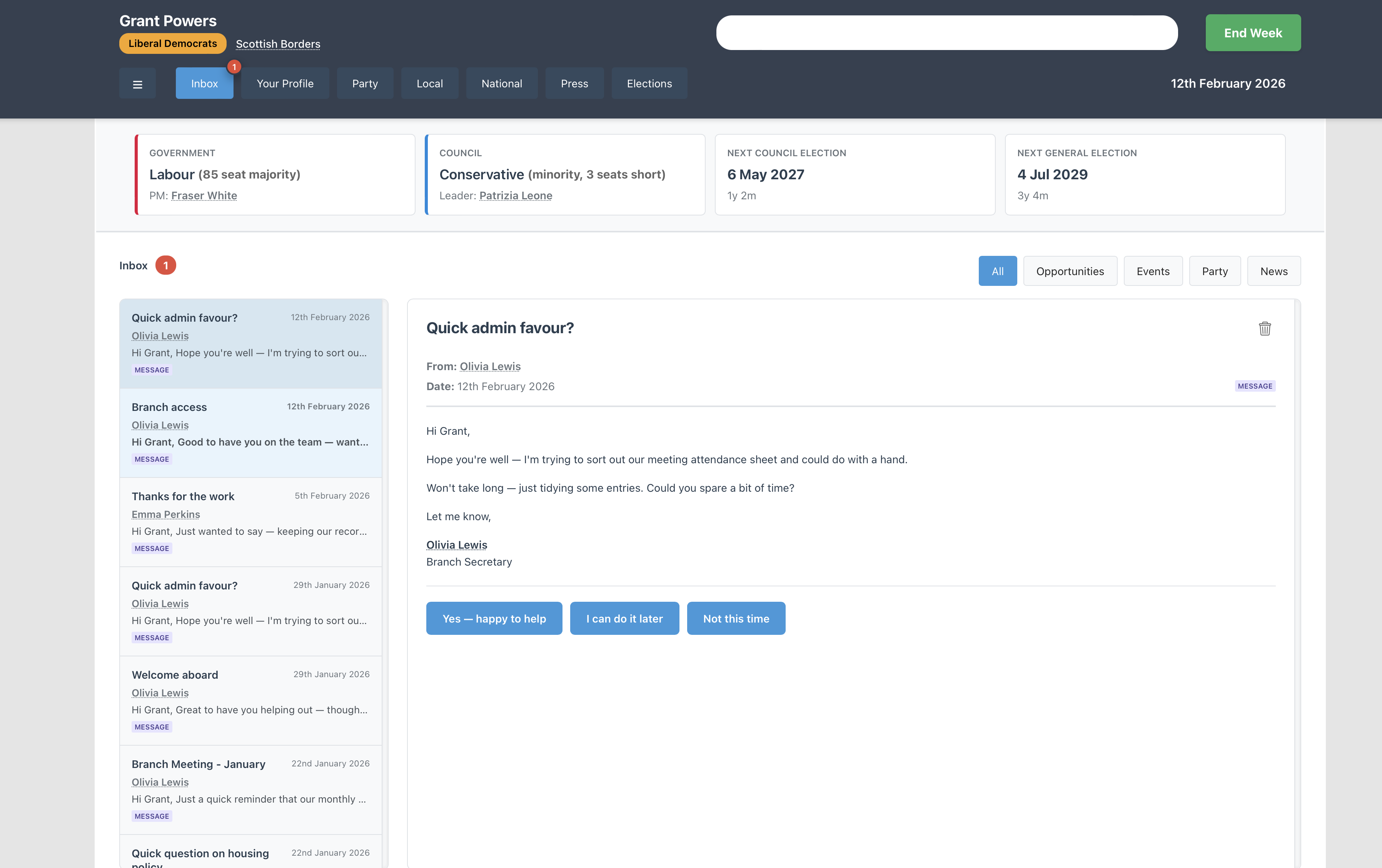
Building relationships is key to success in the game.
¶ Not all friends are easy to make
The mathematics behind relationship building are not easy to game. And by that, we mean it's as close to impossible as you're going to get. Many different factors go into relationship-building, and their impacts vary and differ.
- Political alignment matters. NPCs with opposiing political views will be less receptive to your charms than colleagues in your own party.
- Attributes - both visible and hidden - play a big part. Some NPCs are naturally trusting, whereas others tend to be more suspicious. This impacts your ability to build relationships with them.
- Context is important. Some NPCs will value certain actions over others. Just because one party colleague hugely appreciates your help leafletting, it doesn't necessarily follow that another colleague will be as receptive.
¶ The Favour Bank
Politics runs on favours. When you help someone, they owe you. When they help you, you owe them.
The game tracks favours owed. A well-stocked favour bank means you can call in support when you need it: a vote, a recommendation, a crucial endorsement. But calling in favours has a cost. Use them too freely and relationships cool. Hoard them too long and people forget they owed you anything.
¶ Decay
Relationships fade without maintenance. That colleague you worked closely with three years ago? If you haven't interacted since, you're drifting back toward strangers.
Active relationships stay strong. Neglected ones decay toward neutral. This means you can't befriend everyone and expect it to last. You have to choose who matters enough to maintain.
¶ Journalists
The press aren't just a faceless machine. Journalists are NPCs with their own personalities, ambitions, and memories.
Your relationship with individual journalists is tracked across multiple dimensions:
- Trust: Do they believe what you tell them?
- Favour: Do they owe you, or do you owe them?
- Respect: Do they take you seriously as a political figure?
These combine into an overall relationship state:
- Allied: A journalist who trusts you and owes you favours. They give you the benefit of the doubt, tip you off to stories, and frame coverage sympathetically.
- Friendly: Professional but warm. They'll hear you out and give fair coverage.
- Neutral: Standard professional distance. No special treatment either way.
- Wary: Suspicious of you. They'll dig harder into your activities and frame stories critically.
- Hostile: Actively adversarial. They're looking for angles to damage you.
Journalists remember how you've treated them. Lie to a journalist and get caught, and they won't trust you again easily. Give someone an exclusive and they'll remember the favour. Build relationships with the press thoughtfully; they can make or break careers.
Different journalists have different personalities and styles. Some are tenacious investigators who'll dig until they find something. Others prioritise access and relationships. Some are cynical veterans; others are ambitious climbers. Learning who you're dealing with helps you navigate media relationships.
¶ Who Matters
Not all relationships are equally important. Key figures include:
Your mentor (if you have one): A senior figure who takes interest in your career. Mentors offer advice, opportunities, and protection. Losing your mentor's support hurts.
The whips: Your relationship with the whips affects how much freedom you get and how seriously your rebellions are treated.
Party leadership: How the leader and their inner circle view you affects ministerial prospects and protection during crises.
Local party figures: The branch chair, key activists, influential members. These relationships affect your standing in your constituency party and your security at selection time.
Rivals: Some relationships are defined by competition. Rivals watch for your failures and exploit your weaknesses. Managing rivals is as important as cultivating allies.
Key journalists: The lobby correspondent who covers your beat. The local paper editor. The columnist who shapes narratives. These relationships affect how you're covered and whether you get warning before bad stories drop.
¶ Personality Affects Everything
NPCs have personalities that affect how relationships develop:
Some people hold grudges longer. Damage their relationship and it takes more to repair. Others forgive easily but also forget your good deeds faster.
Some people respond strongly to positive interactions. A small kindness earns outsized goodwill. Others are harder to impress but also harder to alienate.
These personality differences mean the same action can have different effects on different people. Learning who responds to what is part of navigating the political world.
¶ Consequences
Relationships affect:
- Opportunities: Good relationships surface opportunities. Bad ones close doors.
- Support: Allies back you in disputes, votes, and contests. Enemies don't.
- Information: People share more with those they trust. You hear about plots and opportunities through your network.
- Coverage: Journalists you've cultivated give fairer coverage. Those you've alienated don't.
- Career: Promotions, selections, and appointments all involve people who have opinions about you.
- Survival: When trouble comes, relationships determine who defends you and who piles on.
The political graveyard is full of talented people who neglected relationships. Don't join them.
For specific questions about relationship mechanics, see FAQs.