You don't just join a party. You navigate one. Parties in UK Politics Simulator are living organisations with their own internal politics, power struggles, and personalities.
¶ Choosing Your Party
At the start of the game, you choose which party to join.
Your choice shapes everything. Each party has different ideological positions, internal cultures, and paths to power. A career in Labour looks nothing like a career in the Conservatives, even if both end at 10 Downing Street.
¶ Ideology
Every political actor in the game has positions on policy issues. Not just "left" or "right", but specific stances on:
- Taxation and public spending
- Immigration
- Climate and energy
- Housing
- Healthcare
- Criminal justice
- Foreign policy
- And more
Each issue also has a salience: how much that person cares about it. Two NPCs might both be moderate on immigration, but if one considers it their defining issue and the other barely thinks about it, they'll behave very differently.
Your character has an ideology. Your party has an ideology. Your constituents have ideologies. When these align, politics is easy. When they diverge, you face hard choices.
¶ Internal Party Politics
Parties are not monoliths. They contain:
Factions: Groups of MPs and members who share ideological tendencies. The party's centre of gravity shifts as factions gain or lose influence. Leadership contests often pit factions against each other.
The leadership: The party leader sets direction, but their authority depends on maintaining support. Weak leaders face plots. Strong leaders can reshape their party.
The whips: The enforcers. They track loyalty, manage discipline, and distribute favours. Your relationship with the whips affects your career prospects and how much freedom you get.
Backbenchers: The rank and file. Backbench opinion matters. A leader who loses the backbenches loses everything.
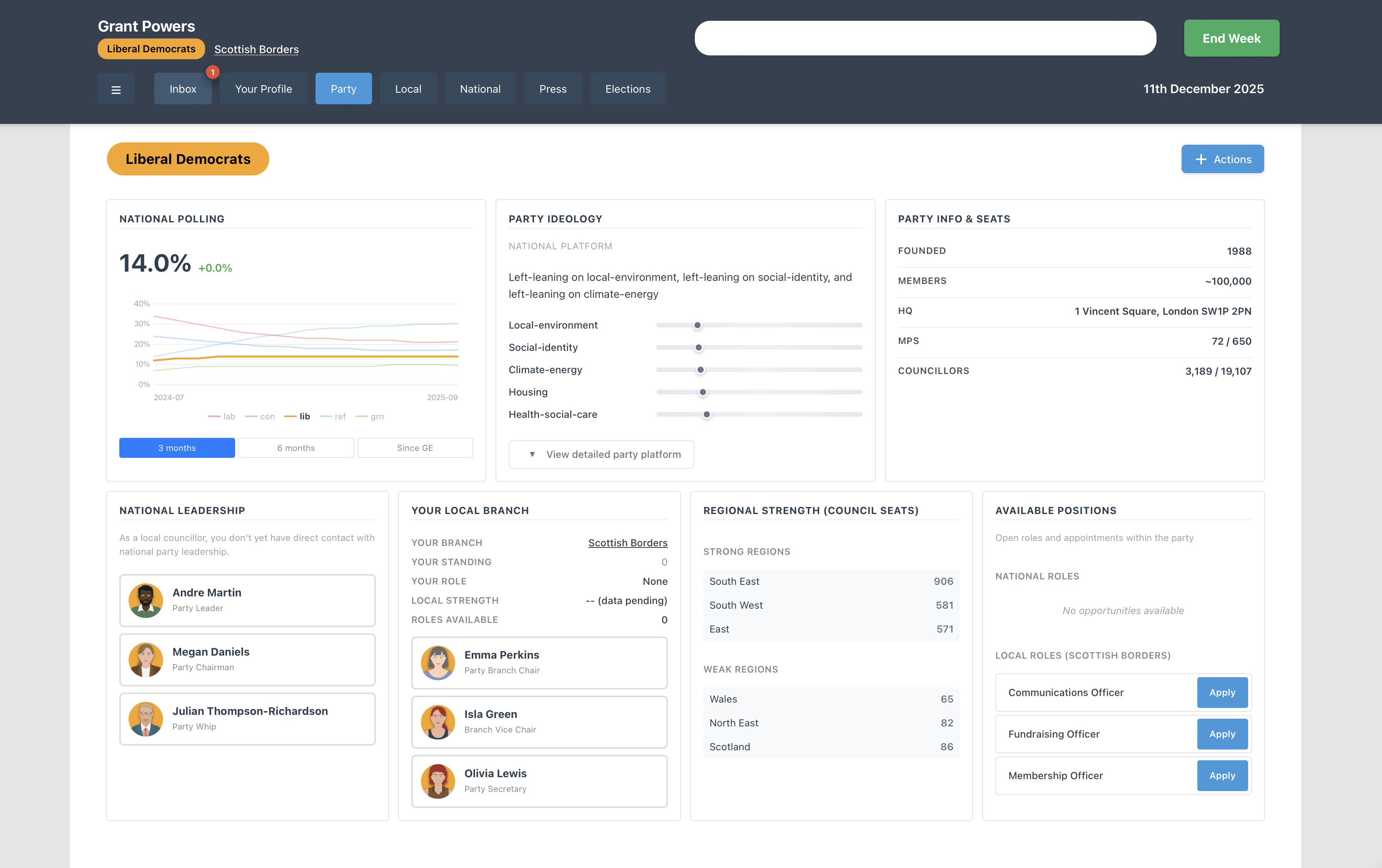
A screenshot showing an early version of the Party screen.
¶ Loyalty and Rebellion
Every vote tests your loyalty. The whips tell you how to vote. You can:
- Follow the whip: Safe, career-building, but you're on record supporting whatever the party supports
- Rebel: Vote against your party on principle (or calculation), damaging your standing with leadership but potentially building an independent reputation
- Abstain: Sometimes possible, sometimes not, depending on the whip level
Your voting record accumulates. Consistent loyalists earn trust and advancement. Serial rebels build reputations for independence but close doors to ministerial office. Most MPs fall somewhere between, picking their battles carefully.
The cost of rebellion depends on context. Rebelling on a minor vote barely registers. Rebelling on a three-line whip during a crisis can end careers.
¶ Leadership
Party leaders rise and fall.
How leaders fall:
- Losing elections (especially badly)
- Sustained poor polling
- Losing parliamentary confidence
- Scandals
- Being too ideologically distant from their MPs
- Accumulating too many enemies
When a leader falls, a leadership contest follows. If you're an MP, you may be able to vote, campaign for candidates, or even stand yourself (if you've built enough support).
As a leader, you control party direction but depend on maintaining coalition. Push too hard against your MPs and you'll face rebellion. Ignore the grassroots and you'll face challenges. Every leader governs within constraints.
¶ The Grassroots
Local party members select candidates, campaign during elections, and can make life difficult for MPs they dislike. Your relationship with your local party matters.
Neglect your constituency party and you may face:
- Deselection threats
- Unenthusiastic campaign support
- Local party motions criticising you
- Challenges to your candidacy
Keep them onside and you have a base of support that can survive temporary unpopularity.
¶ Party Reputation
Your standing within the party is tracked across multiple dimensions:
- Local party: Your relationship with your branch or constituency association
- National party: How leadership and the party apparatus view you
- Factional standing: Where you sit in internal ideological battles
These can diverge. You might be beloved locally but mistrusted by leadership. You might be a leadership favourite but seen as out of touch by grassroots. Managing these competing pressures is part of the game.
¶ Government and Opposition
Your party's position relative to power transforms your experience.
In government:
- Your party makes policy (within coalition constraints, if applicable)
- Ministerial jobs are available
- You're defending a record, not just attacking
- Internal discipline tightens
In opposition:
- You're attacking, not defending
- Shadow cabinet positions matter for profile-building
- More freedom to develop independent positions
- Preparing for the next election
A general election that flips government and opposition changes everything overnight.
For specific questions about party mechanics, see FAQs.